
NHL jerseys have changed five times since 1917, from wool sweaters to CCM air-knit to Reebok Edge to Adidas Adizero to Fanatics. Each transition was triggered by a contract change or a material failure significant enough to require a full league reset.
How NHL Jersey Technology Changed from Reebok Edge to Adidas
Five distinct manufacturing eras define the NHL sweater. Each was triggered by either a league-wide contract change or a material technology shift significant enough to require a full-season transition.
Era | Details |
|---|---|
WOOL ERA 1917–1950s | Early NHL sweaters were heavy knitted wool that absorbed sweat and water, adding weight during games. Jerseys showed only team names or city abbreviations, no player names. Teams supplied their own uniforms until league-wide manufacturing appeared in the 1940s–50s. |
CCM / AIR-KNIT 1970s–2006 | CCM introduced Air-Knit fabric, making jerseys lighter and more breathable than wool. Stars like Gretzky, Lemieux, and Yzerman wore CCM sweaters. Some jerseys included double hem tags for players who tucked them. CCM branding moved to the collar in the 1990s, while Starter, Koho, and Nike briefly produced select jerseys. |
REEBOK EDGE 2007–2017 | Debuted at the 2007 NHL All-Star Game. Edge 1.0 used X-trafil moisture-wicking fabric marketed as lighter and more absorbent. Player complaints led to Edge 2.0 in 2008, which returned to air-knit fabric and added reinforced elbows and wider sleeves. The NHL collar shield was redesigned in 2011 after player feedback. |
ADIDAS ADIZERO 2017–2024 | Introduced with the 2017–18 season after a 2015 partnership announcement. Authentic Made in Canada (MiC) jerseys were team-issued only, while retail “Indo-Authentic” versions were produced in Indonesia. MiC jerseys feature distinctive shoulder dimples. The Primegreen update (2021–22) added at least 50% recycled materials and improved crest embroidery. |
FANATICS 2024– present | Fanatics became the NHL’s official on-ice jersey supplier starting with the 2024–25 season under a 10-year agreement. Production continues in many of the same facilities used during the Adidas era, while Adidas still works with teams on off-ice apparel. |
FACT
The Reebok Edge 2.0 jersey debuted at the 2008 NHL Winter Classic, the first outdoor Winter Classic game between the Buffalo Sabres and Pittsburgh Penguins, both wearing throwback uniforms.
Authentic Adidas MiC (Made in Canada) jerseys are never sold at retail, they are only team-issued or game-worn. Any Adizero jersey sold through standard stores is the Indonesian retail version.
The shift from Reebok to Adidas NHL jerseys occurred in two stages: Adidas was announced as the new supplier in September 2015 and first revealed the Adizero design at the 2016 World Cup of Hockey. The full league rollout, including the Vegas Golden Knights inaugural jersey, happened on June 20, 2017.
ADIZERO AUTHENTIC (RETAIL)
- Made in Indonesia
- Stretchier, softer material than on-ice version
- Fight strap present
- Factory customisation often single-layer stitched vinyl
- Crest embroidery: standard twill
- No shoulder dimples
- Available at retail
ADIZERO MiC (MADE IN CANADA)
- Made in Canada, team-issued only
- Air-knit material, stiffer and more durable
- Double-layer reinforced fight strap
- On-ice customisation: stacked kiss-cut twill
- Primegreen (2021+): dimensional embroidery on crest
- Visible shoulder dimples
- Not sold at retail. Only via game-worn channels.
Reverse Retro: What the Program Is and Why Fans Divided Over It
The Reverse Retro program launched in 2020 through a collaboration between the NHL and Adidas. Every team produced a jersey inspired by a historical uniform with the colour palette remixed or inverted, simultaneously a throwback and something no team had actually worn before.
The first edition launched for 2020-21, covering all 31 teams. A second followed for 2022-23, expanding to all 32. Each jersey takes 18 to 24 months from design approval to delivery.
Team / Edition | Historical Source | What the Design Does |
|---|---|---|
Pittsburgh Penguins RR 2020 | 1997 diagonal lettering jersey | Black jersey with diagonal ‘PITTSBURGH’ text, made famous by Lemieux. The cultural reach: Snoop Dogg wore the same jersey in a different arena that season. RR 2020 flipped it to white; RR 2022 restored the diagonal ‘PITTSBURGH’ on black with additional gold and white sleeve accents. |
Edmonton Oilers RR 2020 | 1979 inaugural season | Oilers’ first NHL season, also Gretzky’s first NHL season. The 2020 Reverse Retro was the first Oilers jersey ever to feature an orange yoke on a white base. |
Colorado Avalanche RR 2020 | Quebec Nordiques colours | The Avalanche began as the Quebec Nordiques before relocating to Colorado in 1995. Their 2020 RR used Nordiques colour elements (blue and red) as a nod to the franchise’s pre-Colorado history. |
Los Angeles Kings RR 2020 | 1989 Forum Blue and Gold | Inspired by the season Gretzky became the all-time NHL scoring leader. The design used the 1990s era Kings logo in the founding Forum Blue and Gold colours the franchise used in the 1960s and 1970s. |
Minnesota Wild RR 2020 | Minnesota North Stars | The Wild’s current logo was reimagined in Minnesota North Stars green and gold – the colours of the franchise that left Minnesota for Dallas in 1993, thirteen years before the Wild were founded. |
Tampa Bay Lightning RR 2022 | 2004 Stanley Cup colours | The jerseys the Lightning wore for their first Stanley Cup championship in 2004, updated with the blue base they wore for their second title in 2020 – layering two championship eras into one design. |
“The cultural impact came from the diagonal lettering jersey Lemieux and Snoop Dogg wore in their respective arenas.”
— NHL.com, on the Pittsburgh Penguins 1997 jersey selected for Reverse Retro 2020
WORTH KNOWING
Reverse Retro jerseys are produced as Adizero Authentic, meaning they carry the same construction tier as the standard retail authentic, not the MiC on-ice specification.
The second edition (2022-23) jerseys were priced at $190–$240 USD at the US retail launch. They are now part of the regular rotation and available as a standard Adizero product.
How to Authenticate an NHL Jersey Before Paying for It
Hockey jersey authentication has a specific complexity not present in basketball or baseball: the existence of two simultaneous product tiers (retail authentic and team-issued) that look superficially identical but have measurable construction differences. A current Morgan Rielly Maple Leafs Fanatics Authentic jersey is a useful reference for modern NHL construction standards.
Check | What to Look For |
|---|---|
✓ Manufacturer matches the era | An Adizero tag on a jersey worn in 1999 is impossible. Match the tag to the known manufacturer timeline: CCM/Koho through 2006, Reebok Edge 2007–2017, Adidas 2017–2024, Fanatics from 2024. |
✓ Fight strap present and correct | Authentic NHL jerseys include a fight strap – a reinforced internal strap that prevents the jersey from being pulled over a player’s head. Replicas (labelled ‘Premier’ in the Reebok era, ‘Breakaway’ in Adidas era) may omit it. Team-issued Edge 2.0 jerseys have a double-layered fight strap; retail Edge 1.0 authentic jerseys have single-layer. |
✓ Crest is embroidered, not printed | Authentic NHL jerseys use embroidered crests with layered twill or dimensional embroidery (Primegreen era). Flat heat-press or printed crests indicate a replica tier or counterfeit. |
✓ Shoulder dimples on Adidas MiC | Made-in-Canada Adidas jerseys have visible textured shoulder dimples – a production mark absent from the Indonesian-manufactured retail authentic versions. If a seller claims MiC without dimples, that is a red flag. |
✓ NHL shield placement and material | Edge-era jerseys have the NHL shield on the collar insert at the front neck (moved from the bottom hem). Pre-2011 Edge jerseys have a hard shield; post-2011 have a softer felt version. An Edge jersey with a soft shield and Reebok vector logo (pre-2011) would be contradictory. |
✗ Numbers and letters are screen printed | Screen-printed customisation is a replica or counterfeit indicator on an item sold as authentic. Authentic numbers use stacked or kiss-cut twill stitching; Primegreen crests use dimensional embroidery with raised surfaces. |
✗ Tag located at the bottom hem (post-2000) | CCM moved its branding from the hem to the back neck collar in the 1990s. A jersey with a hem tag after 2000 and claiming to be authentic is inconsistent with the manufacturer’s known tag placement history. |
RED FLAG
The Indo-Edge (Indonesian Reebok Edge) jerseys exist as a third category within the Reebok era. They are made in Indonesia, use air-knit fabric slightly thinner than the Edge 2.0, and have a white fight strap rather than the team-colour-matched strap on Edge 2.0s. They are a legitimate retail product, but are sometimes sold as team-issued or Edge 2.0 equivalents without that distinction being disclosed.
Seattle Kraken, Anaheim Ducks, Colorado Avalanche: New Identity Kits
Three franchises represent different chapters of NHL visual identity, each demonstrates a different kind of design decision, and each has a distinct relationship with its jersey history.
Seattle Kraken
Expansion franchise, 2021–present
Deep sea blue · Trident red · Ice blue secondary · Nautical design language
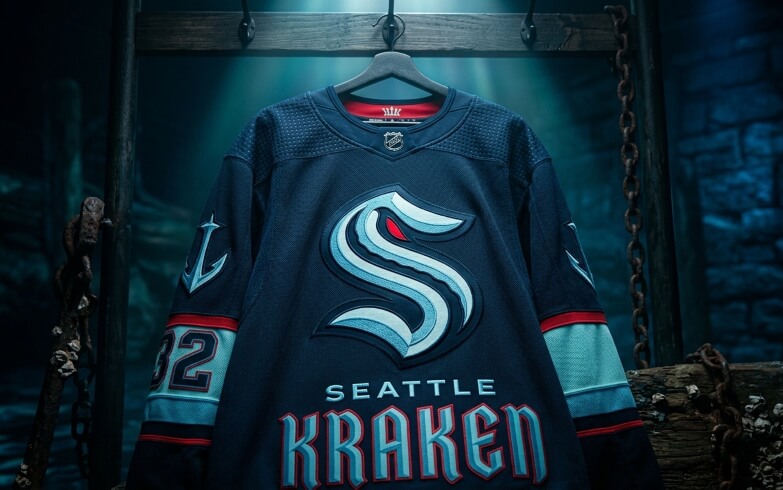
Seattle joined the NHL in 2021 as the league’s 32nd franchise. The Kraken identity was developed over several years ahead of the expansion announcement, drawing on Pacific Northwest coastal themes, the region’s maritime history, and the colour system of Seattle professional sports.
The primary logo features a stylised ‘S’ shaped like a tentacle, with a red circle functioning as the creature’s eye. Deep sea blue, trident red, and ice blue form the base palette. The jersey became one of the best-selling in the league in its first seasons, an unusual commercial result for an expansion team still building its fan base. The Kraken jersey now represents modern expansion-era NHL identity built entirely from scratch.
Anaheim Ducks
Mighty Ducks era (1993–2006) → Modern Ducks (2006–present)
Mighty Ducks: eggplant, jade, silver, black · Modern Ducks: black, gold, orange
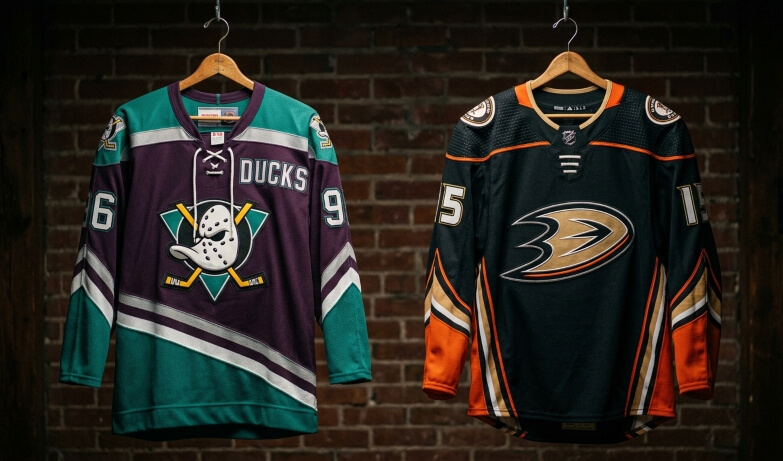
The Mighty Ducks of Anaheim launched in 1993 with one of the most distinctive visual identities in NHL history: eggplant (dark purple), jade green, silver, and black, anchored by a cartoon goalie mask logo derived from the Disney film that inspired the franchise.
In 2006, the team dropped ‘Mighty’ from its name and replaced the entire visual identity with a modernised duck-foot ‘D’ in black, gold, and orange. The original Mighty Ducks uniform is now among the most sought-after throwback designs in the league, partly because the design was so visually unusual for a sport that has historically favoured conservative palettes.
Colorado Avalanche
Relocated from Quebec Nordiques in 1995; won the Stanley Cup in 1996 and 2001
Burgundy · Blue · Silver · Black trim
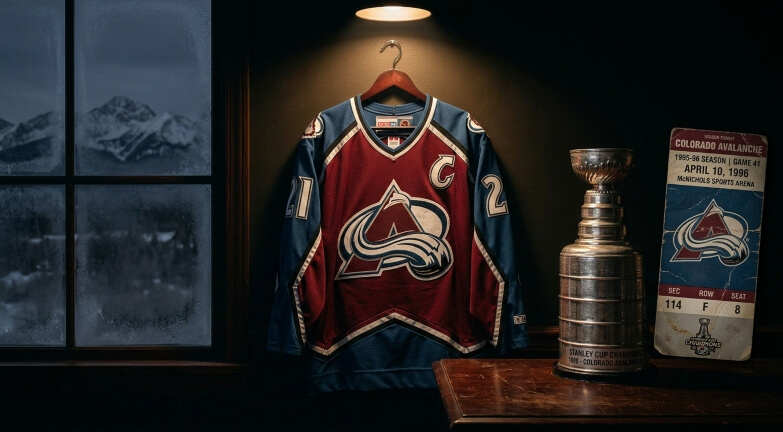
The Quebec Nordiques relocated to Colorado in 1995, becoming the Avalanche. The new franchise retained several key players from the Nordiques roster, including the Sakic/Forsberg core, and won the Stanley Cup in their first Colorado season (1995-96).
The burgundy and blue identity has remained essentially stable since 1995. For a franchise only 30 years old in Colorado, the Avalanche have unusual visual consistency – few major redesigns, no era of experimental colours. The 1996 championship season sweater is the primary collector reference.
Wayne Gretzky Oilers, Mario Lemieux Penguins: The Jerseys That Defined Eras
Wayne Gretzky – Edmonton Oilers
1979–1988, four Stanley Cup championships
Oilers orange and navy · #99 · The Great One era
Gretzky played his first NHL season with Edmonton in 1979-80 – the season the Reverse Retro 2020 Oilers jersey referenced, producing the first-ever Oilers jersey with an orange yoke on a white base as a nod to that inaugural year.
His #99 was retired league-wide when Gretzky retired in 1999, the only league-wide number retirement in NHL history, equivalent to Bill Russell’s #6 in the NBA.
Mario Lemieux – Pittsburgh Penguins
1984–1997 and 2000–2006; back-to-back championships 1991–1992
Black and gold · Robo Penguin crest · 1992 diagonal ‘PITTSBURGH’ lettering
The Penguins’ 1992-93 jersey, featuring a diagonal ‘PITTSBURGH’ text across the chest, became one of hockey’s most recognised designs beyond the sport itself. It was worn by Lemieux during his sixth scoring title season. The same jersey was famously worn by Snoop Dogg in a different arena during that season, one of the clearest examples of hockey jerseys crossing into hip-hop fashion culture.
FOR COLLECTORS
The CCM era Oilers and Penguins jerseys are the most specific historical purchases in the Gretzky and Lemieux lineages. These use heavy air-knit polyester, tackle-twill numbers and lettering, and carry CCM hem or back-neck tags depending on the year. A Gretzky Oilers jersey without those construction markers is from a different era of reproduction.
NHL Sizing: Why Hockey Jerseys Run Differently Than Basketball
NHL jerseys are designed to fit over shoulder pads, chest protectors, and elbow pads, adding roughly 4 to 6 inches of circumference. For a fan wearing no equipment, your clothing size will feel considerably oversized.
Label | Chest (fan fit) | Waist (fan fit) | Over Pads Reference | Buying Notes |
|---|---|---|---|---|
S (Fan) | 35–37″ chest | 28–30″ waist | Over shoulder pads: ~40–42″ chest | Size down 1–2 from your everyday shirt S if no pads |
M (Fan) | 38–40″ chest | 30–32″ waist | Over shoulder pads: ~43–45″ chest | Most common fan size; sits at mid-thigh |
L (Fan) | 41–43″ chest | 33–35″ waist | Over shoulder pads: ~46–48″ chest | Consider XL if wearing over bulky base layers |
XL (Fan) | 44–47″ chest | 36–39″ waist | Over shoulder pads: ~49–52″ chest | If buying for streetwear only, this is the comfortable fit for most L chest sizes |
2XL | 48–51″ chest | 40–44″ waist | Over pads: ~53–56″ chest | At this size, the jersey drapes noticeably below the hip |
52 / 54 | Player cut sizes | Game-issued spec | No pads reference — player-spec fit | Adidas MiC and Fanatics on-ice jerseys use numeric sizing (46–60+); these require measuring the chest flat against garment spec |
NBA throwback jerseys like the Vancouver Grizzlies Ja Morant version fit true-to-size, while NHL jerseys run larger because they are designed for padding.
TIP
If buying a hockey jersey purely for streetwear, most people find sizing down one (sometimes two) produces a fit closer to how the jersey looks on broadcast. A 40″ chest that wears clothing size Large typically gets a better drape at size Small or Medium in an NHL fan jersey.
The numeric sizing used for on-ice (player) jerseys (46, 48, 52, 54 etc.) refers to the chest circumference in centimetres, not US standard sizing. A numeric 52 is approximately equivalent to a fan jersey XL.
NHL Hockey Jersey | NBA Basketball Jersey | MLB Baseball Jersey | |
|---|---|---|---|
Designed to fit over | Protective equipment | Athletic body, no pads | Athletic body, no pads |
Intended silhouette | Oversized; wide shoulders and long sleeves | Close athletic fit | Relaxed athletic; tapered at waist |
Chest at size L | ~41–43″ (fan jersey) | ~41–44″ (Swingman) | ~41–44″ (Flex Base) |
Shoulder width at L | Noticeably wider than clothing equivalent | Standard athletic shoulder | Standard athletic shoulder |
Usual fan recommendation | Size S–M for streetwear without pads | True to size or size down 1 | True to size |
Tuck behaviour | Worn untucked; long hem by design | Short hem; worn untucked | Longer hem; worn untucked |
NHL Jersey Questions Answered
The term dates back to the NHL’s early years (from 1917), when uniforms were knitted wool sweaters similar to everyday winter clothing. Even though modern NHL jerseys use synthetic fabrics, the word “sweater” remains part of hockey culture and is still used officially by the league.
The Breakaway jersey is a replica tier, similar to the Reebok Premier. It copies the design but uses lighter fabric, simpler embroidery or printing, and may omit the fight strap. The Adizero Authentic jersey includes the fight strap, embroidered crest, and Adidas Adizero material. The Made-in-Canada Adizero (MiC) version sits above both and is available only as team-issued or game-worn.
Producing an NHL Reverse Retro jersey takes about 18–24 months, including design approval, materials, and manufacturing. Because of this long production cycle, the NHL releases new editions every two to three years. The second edition in 2022–23 included all 32 NHL teams, while the first (2020–21) had 31 before Seattle joined.
Yes. Wayne Gretzky’s #99 was retired across the entire NHL on April 18, 1999. It remains the only league-wide retired number, meaning no player on any NHL team can wear #99.
Made-in-Canada (MiC) Adidas jerseys have distinctive shoulder dimples, a textured pattern absent on Indonesian retail versions. MiC jerseys are team-issued only, while any Adidas Adizero jersey sold through standard retailers is the Indonesian retail authentic version.