
The history of NBA shorts is quite interesting. Over time, they changed from very short to very loose and baggy and later moved back toward a more balanced style. These changes were not only about fashion. They were shaped by players’ preferences, popular culture, and even a little superstition.
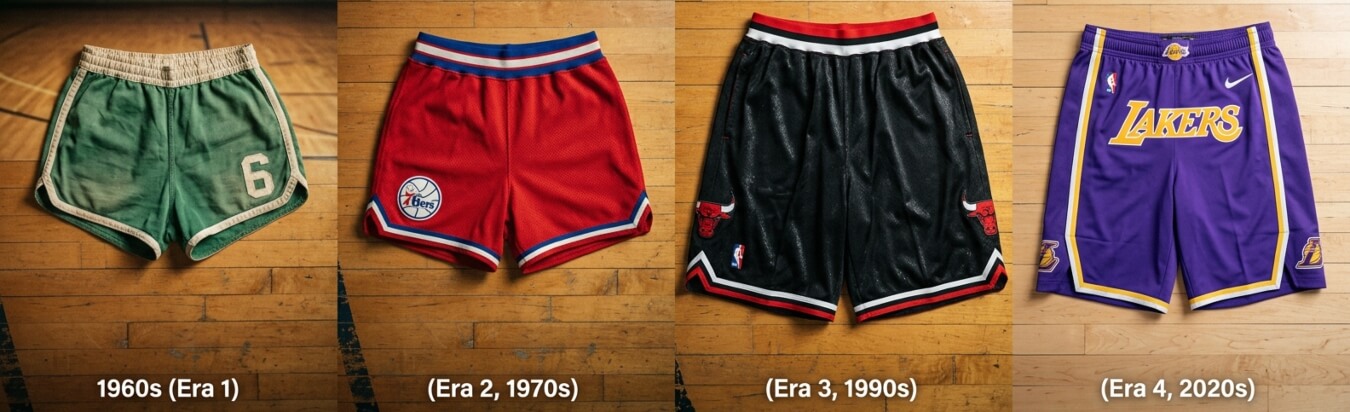
Why NBA Shorts Were So Short in the 1970s and 1980s
When the NBA began in 1946, shorts were long and cotton-heavy. They narrowed and shortened through the 1950s and 1960s as synthetic fabrics replaced cotton and athleticism replaced formality as the dominant value in sports design. By the 1970s, the short-short was not a statement, it was simply the standard across sports: running, football, tennis, and basketball all pointed in the same direction.
Inseams through this era measured around three to four inches. The leg opening was approximately twelve inches across. This was consistent with the general menswear of the period, which ran slim and short for active clothing. The practical argument was genuine: less fabric meant less heat and less resistance during lateral movement. No one was questioning it.
Era | Style | Inseam | What Drove It |
|---|---|---|---|
1940s–50s | Long cotton shorts | 10–12-inch inseam | Modesty-first; heavy fabric; game was slower and less athletic |
1960s | Shorter cotton blend | ~6–8-inch inseam | Transition decade; Wilt Chamberlain dominates; shorts start rising |
1970s | Tight short shorts | ~3–4-inch inseam | ABA influence; polyester; Larry Bird and Magic Johnson era aesthetic |
Early 1980s | Same short shorts | ~3–4-inch inseam | Consistent with 1970s fashion; peak of the short-shorts era |
1984 | Jordan requests longer cut | ~6–7-inch inseam | UNC shorts worn underneath; Bulls shorts lengthened to compensate |
Late 1980s | Gradual lengthening | ~7–8-inch inseam | Jordan’s new look spreads; teams begin updating their own cuts |
Early 1990s | Fab Five baggy | 9–10-inch inseam | Michigan Wolverines popularise the oversize look; hip-hop culture merges |
Mid-1990s | Full baggy era | 10–11-inch inseam | League-wide; NBA rule introduced requiring shorts 1 inch above knee |
2000s | Peak length | 11–12 inch inseam | Shorts hang 4+ inches below knee; John Stockton retires 2003 still in short-shorts |
2010s | Trim-down begins | 9–10-inch inseam | LeBron James requests tailored custom pairs; college game starts shrinking lengths |
2020s | Athletic mid-length | ~8–9-inch inseam | Current standard; shorter than 2000s peak but nowhere near 1970s |
IMPORTANT DETAIL
NBA shorts have changed a lot over the decades. The inseam once measured about 3 inches, later grew to around 11 inches during the baggy era, and today most Nike Swingman shorts sit in the middle at about 8–9 inches. In other words, the style has gone full circle over the past sixty years.
One player who never followed the trend was John Stockton of the Utah Jazz. He kept wearing classic short shorts throughout his entire career. When he retired in 2003, he was the last NBA player still using that pre-Jordan style – a detail often mentioned in stories about the evolution of NBA fashion.
“Former Utah Jazz point guard John Stockton made basketball fashion history by being the last professional player to hold on to the shorter look, until he retired in 2003.”
— Esquire Philippines, on the evolution of NBA shorts
How Michael Jordan Changed NBA Shorts Forever
Michael Jordan joined the Chicago Bulls in 1984 as the third overall pick in the draft. He arrived from the University of North Carolina with a habit and a superstition: he had worn his UNC shorts underneath his game shorts since the Tar Heels’ 1982 NCAA championship, believing them to be lucky.
The practical problem was immediate. His UNC shorts, standard college short shorts, would not fit under the Bulls’ game shorts without showing. Jordan’s solution was to request longer game shorts: enough additional length to cover the Carolina blue underneath the Chicago red and black. His Bulls shorts were lengthened by several inches to compensate.
KEY FACT
Byron Scott, former Lakers player and coach, recalled the exact mechanism on his podcast: “MJ started that, cause he wanted to wear his North Carolina shorts under them, and they were too long, they were sticking out. So they increased the Chicago Bulls shorts longer just so it could cover that North Carolina blue.”
The request had a secondary cause. Jordan also had a tendency to tug his shorts during play, specifically when bending to catch his breath on defence. A slightly longer, looser cut worked better for this. The two reasons reinforced each other, and by the mid-1980s, Jordan was consistently wearing shorts with an inseam several inches longer than league standard.
The effect spread in stages. First, other players in the Bulls’ circle adopted the style. Then the broader league began lengthening its shorts in response to player requests, several of which explicitly cited Jordan’s look. By the early 1990s, five players from the University of Michigan, Jalen Rose, Chris Webber, Jimmy King, Ray Jackson, and Juwan Howard, known collectively as the Fab Five, wore oversize shorts as a deliberate fashion statement, pushing the length further than Jordan had. They cited both Jordan’s influence and hip-hop culture as the dual origin of their look.
“It is not up for debate that the Fab Five popularized the baggy shorts to kids like us, all thanks to MJ’s, and hip-hop, let’s be serious here, influence.”
— Gameday Grails, on the Fab Five’s role in the length shift
By the mid-1990s, the shift was complete across all levels of the game. The NBA noticed the length creeping so far down that it introduced a rule in 1997 requiring shorts to remain at least one inch above the knee. Players who went lower were fined. The rule was later revoked, but its brief existence signals exactly where the culture sat: shorts had gone from three-inch inseams to touching the calf in thirteen years.
Retro NBA Shorts: Bulls, Heat, Magic, Lakers by Era
Four franchises dominate the retro shorts conversation, and each for a different reason. The Bulls, because of Jordan and the championship years. The Heat, because of the Vice series, which created commercial demand that exceeded any uniform campaign in NBA history. The Magic, because their pinstripe design remains one of the most visually distinct shorts ever worn in the league. The Lakers are the only franchise to span more decades of the NBA’s short history.
Chicago Bulls
1984–98 Champion / Adidas era
Red & black; #23 and #91
The most sought-after shorts in the retro market. The black-pinstripe alternate worn in the mid-1990s is especially rare. The team wore it only for specific games. Jordan’s 1984 request for a longer cut begins here. The transition from short 1984 shorts to baggy 1990s equivalents is visible across the six championship seasons.
Miami Heat
1988–99 Champion era
Black road, white home, red alternate
Miami’s original shorts are black with the team’s “flaming ball” logo on the right leg – a design element that returned in various forms through the Vice era. The 1990s black road shorts predate the Vice aesthetic by decades but share its instinct for colour contrast. Worn through the Alonzo Mourning and Tim Hardaway years.
Orlando Magic
1989–98 inaugural era
White with black/blue pinstripes + stars
Worn through the franchise’s first nine seasons, including the 1994–95 Finals run with Shaquille O’Neal and Penny Hardaway. The pinstripe pattern was unique among NBA teams of the era. The Magic reverted to full pinstripes for the 2025-26 season after fan pressure spanning three decades.
Los Angeles Lakers
1960–2000 multiple eras
Gold home / purple road / white alternate
Lakers shorts span six decades of NBA history, from the Minneapolis-era wool shorts of the early 1960s through the Showtime gold of the 1980s and the Shaq/Kobe purple of the 2000s. The 1984–85 gold home shorts, Kareem Abdul-Jabbar’s final championship season, represent the peak of the short-shorts era for the franchise.
The Just Don collaboration, a joint project between Mitchell & Ness and designer Don C, sits in a category of its own. Don C produced limited-edition reproductions of specific Hardwood Classics shorts (Bulls, Lakers, Heat, and others) with denim and leather accent panels replacing standard mesh. These were produced in very limited runs and are now collector items, not wearables. They established a precedent for treating game shorts as fashion objects, which has influenced the broader retro market since 2016.
WHAT TO REMEMBER
The Miami Vice shorts design refers specifically to the 2017-18 City Edition campaign, not the 1990s originals. The original Heat shorts from 1988–99 were black with minimal trim.
The Vice series launched five colourways over four seasons: white (2017), black/Vice Nights (2018), pink/Sunset Vice (2018), blue/ViceWave (2019), gradient/ViceVersa (2020). All five are distinct designs. The black Vice Nights version returned for the 2025-26 season.
How to Size NBA Shorts When You’re Between Sizes
Retro and modern shorts diverge significantly in how they fit. The same waist measurement produces a very different garment depending on which era you’re buying. The problem is compounded because vintage and reproduction shorts often use elastic waistbands that stretch generously, making the label size a rough guide at best.
Size | Waist | Modern Inseam | Retro Inseam | Fit Notes |
|---|---|---|---|---|
S | 28–30″ | Modern: ~8–9″ | Retro: ~10–11″ | Retro Swingman and Hardwood Classics run loose; a modern S in retro often fits like a relaxed M |
M | 30–32″ | Modern: ~8–9″ | Retro: ~10–11″ | Most versatile size; retro shorts from the 1990s in M hit mid-thigh on a 5’10” person |
L | 33–35″ | Modern: ~9″ | Retro: ~11″ | Standard fan size; retro L drops below the knee on most body types |
XL | 36–39″ | Modern: ~9″ | Retro: ~11–12″ | Retro XL approaches mid-calf; if wearing as streetwear, consider sizing down one |
2XL | 40–44″ | Modern: ~9–10″ | Retro: ~11–12″ | Same caveat; the elastic waistband in 1990s shorts stretches significantly on retro styles |
TIP
Retro shorts from the 1990s were designed to be worn low on the hips. The waistband was not meant to sit at the natural waist. If you buy a retro pair in your exact waist measurement, they will feel tight unless worn low.
Always measure the flat garment width, not just the label. A retro Large often measures 18–20 inches across the waistband when flat, stretching to 36–40 inches total, close to a modern XL.
Mitchell & Ness Hardwood Classics shorts follow a slightly different size convention from Nike Swingman. The Hardwood Classics tend to run one size larger in the waist and are cut in the authentic baggy silhouette of their era, including the full inseam length. If you need a closer modern fit, size down one from your usual. If you’re buying for the historical look, worn low and loose as they were on court, buy your true waist size.
KEEP THIS IN MIND
Champion-era originals from the 1980s and early 1990s are smaller and boxier than reproductions. A vintage Champion Large routinely measures the same waist as a modern Medium or Small.
Always check garment measurements on vintage, not the label. A 1992 Magic Large may fit a 30–31-inch waist. The same size label in a modern reproduction fits a 34–36-inch waist.
Shorts vs Uniform Sets: What to Buy and When
The decision between buying shorts alone or a matched jersey-and-shorts set is less about preference and more about purpose. Both have specific use cases, and the wrong choice for your situation is an easy mistake to avoid.
What You’re Deciding | Shorts Only | Full Uniform Set |
|---|---|---|
Historical accuracy | Shorts only – specific season | Full set ties you to one specific year |
Cost | Lower entry point | Higher; jersey + shorts together |
Wearability | Mix with any top | Best worn as a matched pair |
Display/collection | Challenging (needs stand/hanger) | Easier to display as a complete uniform |
Common reason to buy | Casual wear; streetwear styling | Game-day; collector; photography |
Size considerations | Waist measurement is the guide | Need to size both pieces; jersey runs larger than shorts |
One important detail: NBA shorts from the 1990s and early 2000s were often sold without matching jerseys in official channels because the jersey was considered the primary product. That means many of the most sought-after retro shorts – Chicago Bulls black pinstripe, Orlando Magic pinstripe, Charlotte Hornets teal – were purchased as separates even when new. Buying them as separates is historically consistent, not a compromise.
NBA Shorts Questions, Answered
Hardwood Classics by Mitchell & Ness are licensed reproductions made to match specific historical NBA seasons. Each pair includes a year tag confirming the season it represents. Standard retro shorts are inspired designs without exact season documentation. Hardwood Classics typically use double-knit polyester and tackle-twill details, while standard retro versions often rely on lighter fabrics and sublimation printing.
In 1997 the NBA introduced a rule requiring shorts to stay at least one inch above the knee. By the mid-1990s, some players wore extremely baggy shorts reaching mid-calf. The league imposed fines for violations, but the rule was later removed as trends shifted and shorts gradually became shorter again.
No. Champion NBA shorts (1977–2000) used a heavy cotton-polyester blend with screen-printed or embroidered lettering and elastic waistbands, usually without drawcords. Hardwood Classics shorts recreate those designs but use modern fabrics and often include a drawcord. The overall silhouette is similar, but the materials and durability differ.
The Miami Vice City Edition series debuted in the 2017–18 season. Inspired by Miami’s neon arena signage and 1980s aesthetics, the design used colors like Laser Fuchsia and Blue Gale. Over four seasons, five colorways were released. The popular Vice Nights (black) version returned for the 2025–26 season, and the team has considered keeping the style permanently.
Yes. Polyester fabrics from vintage 1970s and 1980s NBA shorts often remain durable. The main issue is fit: inseams were only three to four inches, sitting high on the thigh by modern standards. Vintage pieces can still be worn as streetwear, but older elastic waistbands may weaken, so checking their condition before buying is recommended.