
Buying an NBA jersey used to be simple. Home, road, maybe one alternate.
Today it’s a different landscape. Association, Icon, Statement, City Edition. Swingman or Authentic. Prices that vary by hundreds of dollars for jerseys that appear almost the same at first glance.
Understanding how the NBA’s jersey system works, from Nike’s edition framework to the details collectors watch for, makes the decision much easier.
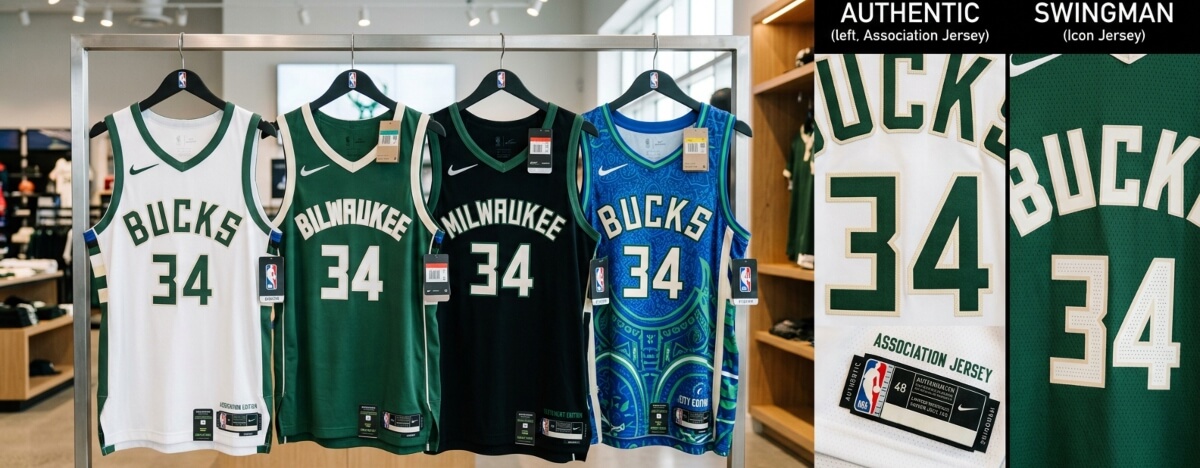
Three Core NBA Jersey Editions
Before 2017, the structure was simple: home whites, road colours, one alternate. Nike’s arrival as the league’s official outfitter changed that entirely. Starting with the 2017-18 season, the NBA replaced the home-and-away designation, introducing a naming system where every jersey is an edition and the home team decides which one to wear each night.
Edition | Colour Base | Visual Identity | When It Appears |
|---|---|---|---|
Association | White base | Replaces old home whites; team colours in trim | Default home jersey for most teams, worn frequently all season |
Icon | Primary team colour | Old road jersey – Bulls red, Lakers gold, Warriors blue | Teams can now designate this as home if they prefer |
Statement | Varies by team | Bold alternates for rivalry games and high-stakes matchups | Games scheduled in advance by the league on LockerVision |
City Edition | Varies by team | Local culture, geography, history – not team colours | Miami Vice series; Phoenix Valley; Memphis Stax Records |
Classic | Throwback design | Issued selectively; e.g. 75th anniversary season teams | Not available every season – only for specific franchise milestones |
KEY FACT
Nike extended its contract with the NBA for 12 years in 2024, keeping the current Association / Icon / Statement / City framework in place through the 2036-37 season.
The schedule for which edition is worn on any given night is posted publicly on the NBA’s LockerVision platform before the season starts.
One practical effect of the change: players no longer choose which jersey goes on. Celtics equipment coordinator John Connor told The Boston Herald in 2018 that under Nike, the team receives a full-year schedule from the league. As he put it, it used to be Paul Pierce saying which jersey to wear, not anymore.
“It used to be Paul Pierce saying, ‘Hey, let’s wear the green/black ones.’ Not anymore. The players can’t control it.”
— John Connor, Celtics travel and equipment coordinator, Boston Herald, 2018
Swingman vs Authentic: The $100 Difference Worth Understanding
Two tiers of NBA jerseys are sold through official channels. The price gap is roughly $150-200 CAD. What you’re buying at each level is more specific than most listings explain.
Swingman | Authentic | |
|---|---|---|
Fabric weight | ~90–100 g/m², light Dri-FIT mesh | ~140 g/m², heavy knit performance mesh |
Name & numbers | Heat-sealed printed twill | Tackle-twill stitched into mesh directly |
NikeConnect chip | Included (optional to use) | Included (optional to use) |
Fit vs. body | Relaxed fan fit, true to size | Player spec – run 1–2 sizes smaller |
Approx. price (CAD) | $100–$130 | $280–$350 |
Best for | Regular wear, game days | Collectors, provenance, display |
THE IMPORTANT PART
The Authentic runs 1–2 sizes smaller than Swingman in the same player’s jersey. A 42-inch chest that wears Swingman Large typically needs XL or above in Authentic.
If the jersey is for display rather than wear, that size gap doesn’t matter. If you plan to wear it, it matters a great deal.
For vintage coverage, Mitchell & Ness produces the Hardwood Classics line: throwbacks made to specifications of specific historical seasons using double-knit polyester with tackle-twill lettering, finished with a felt player and year identifier at the lower left hem. These cover the Champion, Adidas, and Reebok eras and allow you to buy a jersey tied to a specific season rather than the current year’s design.
WATCH OUT
Older jerseys from the Champion, Adidas, and Reebok eras often run much smaller and boxier than modern Nike styles.
A 90s Champion Large feels closer to a modern Medium or even Small. Always check garment measurements, not the label, when buying vintage.
NBA Numbering Rules and Why Some Numbers Are Retired
The NBA has no league-wide numbering rule equivalent to the NFL’s position-based number system. Players choose any available number from 0 to 99, subject to their franchise’s retired list and league approval. Numbers above 68 are effectively never approved, and three-digit numbers are not permitted under standard league rules.
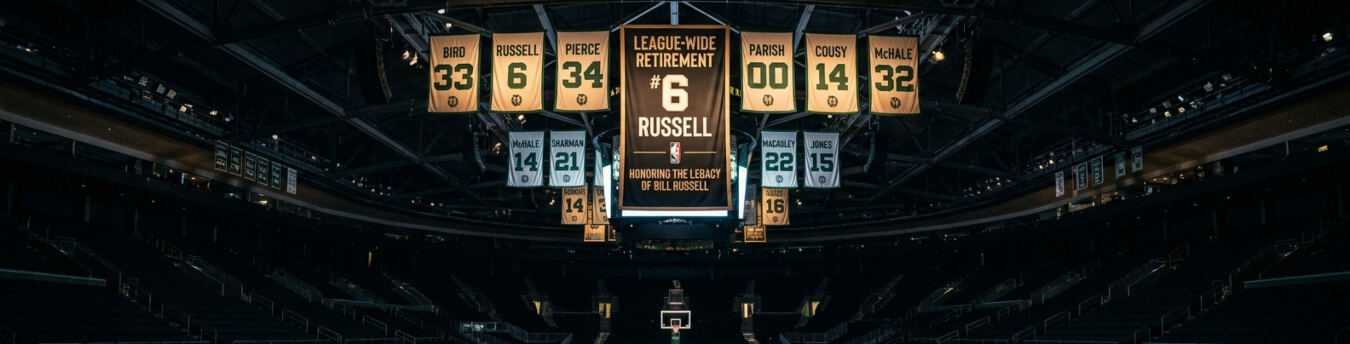
24
Celtics retired numbers
14
Players with 2+ teams retiring their number
1 (Bill Russell #6)
League-wide retirements
The full retirement picture across notable numbers:
Number / Player | Franchise(s) | When Retired | What Makes It Notable |
|---|---|---|---|
#6 – Bill Russell | League-wide (all 30 teams) | August 2022, 12 days after Russell’s death | Only league-wide NBA retirement; players wearing it at announcement kept the number |
#23 – Michael Jordan | Chicago Bulls + Miami Heat | Bulls: retired 2003; Heat: during ceremony | Heat retired it despite Jordan never playing for them – one of 4 players honoured by teams they never played for |
#8 and #24 – Kobe Bryant | Los Angeles Lakers (both) | December 18, 2017 | Only player in NBA history with two numbers retired by the same franchise |
#1 – Derrick Rose | Chicago Bulls | January 24, 2026 | Fifth Bull to receive the honour; joins Jordan (#23), Pippen (#33), Love (#10), Sloan (#4) |
#15 – Vince Carter | Toronto Raptors + Brooklyn Nets | Raptors: Feb 2023; Nets: previously | One of 14 players to have numbers retired by two different franchises |
COLLECTOR NOTE
Derrick Rose’s #1 Bulls jersey entered the permanent retired-number category on January 24, 2026, joining Jordan (#23), Pippen (#33), Bob Love (#10), and Jerry Sloan (#4).
Jerseys from his 2010-11 MVP season in the Adidas Edge template are the most specific historical artefact; the green alternate worn twice that season has its own collector figurine giveaway from the Bulls.
The Most Iconic NBA Jersey Designs by Era
Jersey design history in the NBA tracks the cultural eras around it. What the league wore in 1965 tells a different story from 1992, and both are completely unlike 2018. The table below covers the designs that have lasted beyond their seasons.
Era | Jersey | Colour Scheme | Why It Lasted |
|---|---|---|---|
1980s | Showtime Lakers | Gold & purple, script ‘Lakers’ | Set the visual standard for the league; still the most-worn non-current jersey globally |
1980s | Boston Celtics | Green & white, classic wordmark | Most retired numbers of any franchise in American sport |
1990s | Chicago Bulls | Red & black, Jordan #23 | Crossed over from sport into fashion globally; black pinstripe alternate became a collector centrepiece |
1990s | Charlotte Hornets | Teal & purple | Spawned the bestselling Starter jacket in NBA history; teal remains the franchise’s visual signature |
1990s | Indiana Pacers (Flo-Jo) | Royal blue, racing stripe | Designed by Florence Griffith-Joyner after an intern suggestion; revived as City Edition throwback |
1990s | Toronto Raptors | Purple, cartoon dinosaur | Mocked at debut; now among the most-sought throwback designs in the league |
2000s | Denver Nuggets pinstripe | Blue, gold, powder blue pinstripe | Carmelo Anthony’s #15 powder blue alternate is the defining early-2000s collector jersey; his Knicks orange #7 covers a separate New York chapter with equal name recognition |
2017–21 | Miami Heat Vice | Black, pink, teal gradient | Tyler Herro wore it during his 2020 playoff breakout, the season that cemented its status; over 500,000 sold; returned as 2025-26 City Edition under ‘The Original Vice Nights’ |
2020–present | Phoenix Suns Valley | Desert pixelated gradient | Camelback Mountain silhouette; became a genuine fan favourite in its first season |
“No colour scheme defines the 90s more than teal and purple, and the Charlotte Hornets are a big reason why.”
— CBS Sports, ranking the most iconic NBA jerseys of the 1990s
The Miami Vice series sits in a separate category from other City Edition designs because it generated its own commercial logic. The Heat brought it back for the 2025-26 season under the label ‘The Original Vice Nights’, which is the clearest possible signal of where it sits in the franchise’s identity.
How to Size an NBA Jersey Without Trying It On
NBA jerseys run closer to the body than hockey or baseball equivalents. The intended fit is athletic: narrow through the shoulders, close in the torso, hem sitting higher on the hip than a standard t-shirt. The Nike Swingman sizing measured around the chest, under the arms:
Size | Chest (in.) | Length (in.) | Authentic Chest | Authentic Length |
|---|---|---|---|---|
S | 35 – 37.5 | 27.7 | 35 – 38 | Tight athletic; XS for slim build |
M | 37.5 – 41 | 28.1 | 38 – 41 | True to size for most |
L | 41 – 44 | 28.9 | 42 – 45 | Most common fan size |
XL | 44 – 48.5 | 29.6 | 46 – 50 | Size up 1 for Authentic |
2XL | 48.5 – 53.5 | 30.4 | 51 – 56 | Size up 1 for Authentic |
3XL | 53.5 – 58 | 31.2 | 57 – 62 | Size up 1 for Authentic |
These are Swingman measurements. Move to Authentic and those numbers shift: plan on one size up across the board, and two sizes for a genuinely comfortable fit if you prefer a looser wear.
TIP
Jersey length at size Large is approximately 28.9 inches – roughly at the hip for someone 5’10” to 6’0″.
If you want coverage past the waistband, size up regardless of chest measurement.
Women buying men’s cut jerseys: measure bust, compare directly to the men’s chest column, or use the Women’s cut which has narrower shoulders and a slightly tapered waist.
LaMelo Ball, Devin Booker, Derrick Rose: NBA Jerseys That Fans Collect
The jerseys with the highest search volume in this category share one feature: there is a story behind the number that most buyers don’t know going in. That story is usually what determines what the jersey is worth beyond its construction tier.
Two others worth noting in the same search tier: Trae Young’s Hawks Icon edition in Atlanta red, his #11 has been the franchise’s top-seller every season since his 2018-19 rookie year, and the Lonzo Ball #2 Pelicans jersey from 2021-22, which covers the last full season before a knee injury ended his active career.
#2 → 1
LaMelo Ball
Charlotte Hornets
NBA since 2020 | Rookie of the Year 2021
Ball arrived in Charlotte wanting #1 – his number since Chino Hills High School, tattooed on his chest. Malik Monk already had it. He took #2 through his first two seasons. His older brother Lonzo Ball wore the same number for the Pelicans and Bulls during that same window, the two Ball jerseys represent parallel careers in the same era, with different endpoints.
“I’m not supposed to wear No. 2 ever again in my life,” he said in April 2022. He switched to #1 for 2022-23 once Monk departed.
The #2 jersey covers his rookie year and first All-Star season – the earlier window of the career. The #1 jersey covers his current peak. Both are teal Hornets; the number is the only distinction.
#1
Devin Booker
Phoenix Suns
NBA since 2015 | 5x All-Star | Suns all-time leading scorer
Drafted 13th overall in 2015, Booker has spent his entire career with Phoenix. He averages 24.8 points per game across 717 career games.
At 20, he became the youngest player to score 70+ points in a game (vs. Boston Celtics). At 22, the youngest with consecutive 50-point games.
Two Olympic gold medals (2020, 2024). His Suns jersey has changed across the Nike era, the Adidas-generation version from his record-breaking early seasons is the historically specific purchase.
#1
Derrick Rose
Chicago Bulls
NBA 2008–2024 | Youngest MVP in NBA history (age 22, 2011)
Averaged 25.0 points and 7.7 assists in his MVP season, leading the Bulls to a 62-20 record and the top seed in the East, the first time since the Jordan era.
His #1 Bulls jersey was retired on January 24, 2026, making him the fifth player so honoured in franchise history.
The most historically specific version: the 2010-11 Adidas Edge template in Bulls red, covering the MVP season. A green alternate from that same season was worn only twice.
“His talent, his speed, his athleticism, his craftiness, his mind. There’s no surprise why he was the youngest, and still is the youngest, MVP in NBA history.”
— LeBron James, on Derrick Rose’s jersey retirement ceremony, January 2026
Common Questions About NBA Jerseys
Mitchell & Ness produces the official Hardwood Classics line: replicas built to the specifications of specific historical seasons, using double-knit polyester with tackle-twill lettering and a felt year identifier sewn into the hem. A ‘throwback’ is a general term. A Hardwood Classic is a licensed product from a specific manufacturer tied to a documented season.
The Authentic is cut to on-court player specifications, longer torso, narrower sleeves, tighter through the body. It is designed to be worn by athletes performing at pace, not for casual streetwear. The Swingman is engineered for fan wear and runs roughly one to two sizes larger for the same chest measurement.
Yes. A jersey bearing LaMelo Ball’s #2 from his rookie season is a historical item even if the Hornets have issued that number to someone else. The jersey refers to Ball specifically through the name on the back. The number alone carries no claim on current players.
Each City Edition gets a specific window in the schedule, assigned by the NBA on LockerVision before the season starts. They are not worn every game. If you’re buying a City Edition jersey associated with a specific game, it’s worth confirming that game used the City Edition matchup for that night.
No. NFL numbers are assigned by position group with specific ranges. NBA numbers have no position requirement. Players choose any available number from 0 to 99, subject to any retired numbers at their franchise and league approval. The only league-wide restriction in the NBA is Bill Russell’s #6.