
Baseball jerseys tell a story of technology as much as design. Since 2015, MLB jersey fabrics have changed several times, with one major update even revised after strong player and fan criticism. The most collectible baseball jerseys are rarely tied only to championships. Instead, their value often comes from unique moments in the sport – a famous crossover into minor league baseball, a star player defining a team’s iconic colours, or the World Baseball Classic creating national team jerseys that appear only once every four years.
Cool Base vs Authentic: The MLB Fabric Story
Cool Base, Flex Base, and Authentic have been used in overlapping ways since Majestic introduced the first of these labels in the mid-2000s, they are not synonyms and do not refer to the same product tier.
MAJESTIC COOL BASE 2015–2016 | MAJESTIC FLEX BASE 2016–2019 | NIKE VAPOR PREMIER 2024 | 2025–2026 REVISION (announced Sep 2024) |
|---|---|---|---|
Fan-facing replica tier | On-field performance cut | 25% more stretch | Larger lettering restored |
Cool Base fabric tech | 10–20% lighter vs prior | 28% faster moisture dry | Embroidered sleeve patches |
Lighter than on-field | Mesh side panels added | At least 90% recycled poly | Full pant customisation |
Retail primary product | Wider range of motion | 300+ players body-scanned | 2023 materials restored by 2026 |
Not game-issued spec | First major stretch upgrade | Dri-FIT ADV construction | MLB + Nike + Fanatics + MLBPA |
Cool Base was Majestic’s consumer-facing replica tier, not built to game-used specifications. Flex Base, introduced for 2016, was the on-field upgrade: lighter twill, mesh side panels, 10 to 20 percent lighter than the prior system.
WORTH KNOWING
Nike took over MLB uniform design starting in 2020. Fanatics, which had acquired Majestic’s manufacturing infrastructure, produced the physical garments, meaning early Nike-branded jerseys came from the same factories that had made Majestic products for the prior thirty years.
The 2024 Vapor Premier rollout involved body scans of more than 300 players. The material uses at least 90 percent recycled polyester yarns and is built on Nike’s Dri-FIT ADV platform.
The Vapor Premier’s first full season, 2024, drew sustained criticism from players and fans: letters appeared smaller, the fabric looked thinner on broadcast, and some players reported fit issues mid-game. In September 2024, MLB announced a coordinated revision with Nike, Fanatics, and the MLBPA: larger lettering would return, sleeve patches would go back to embroidery, full pant customisation would be restored, and by 2026, the material would revert to the 2023 specification.
“We wanted to take a meaningful step forward in terms of on-field performance. But we also heard the feedback from players and fans, and we’re making changes.”
— MLB statement on 2025–2026 uniform revisions, September 2024
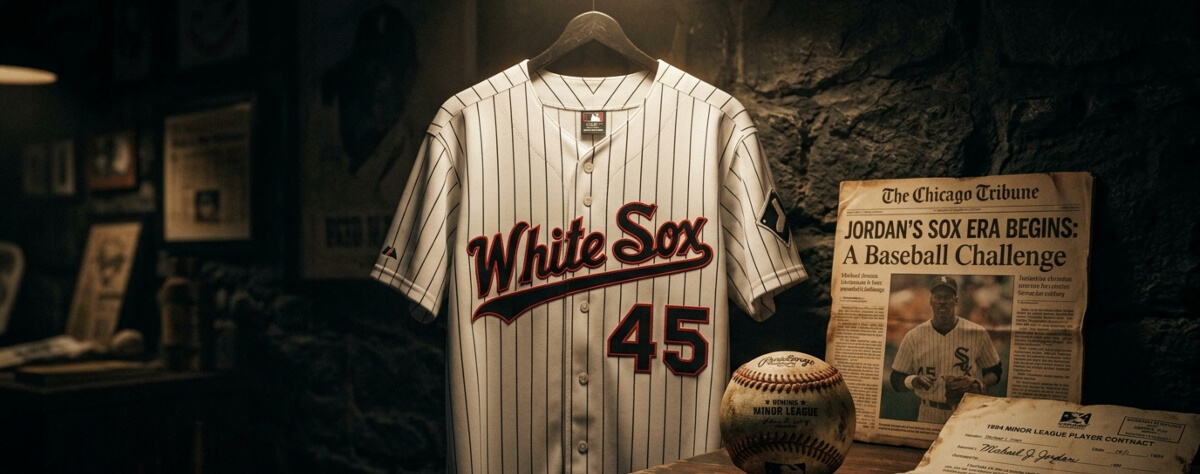
Michael Jordan’s White Sox #45: Why It’s Still One of the Most Wanted
The Michael Jordan White Sox jersey occupies a category no other baseball jersey does. In February 1994, Michael Jordan signed a minor league contract with the Chicago White Sox, making his Michael Jordan baseball jersey one of the few items in the sport whose value is entirely independent of baseball performance.
#45
Michael Jordan
Chicago White Sox
February 1994 – March 1995
Jordan wore #45 rather than #23, which he considered retired from his basketball career. He reached Double-A Birmingham before returning to the Bulls in March 1995. His baseball statistics were ordinary.
The value of the jersey comes entirely from the crossover: the intersection of the greatest basketball player in history with a specific MLB franchise in a narrow two-season window has no equivalent in American sports history. In 2019, White Sox outfielder Jon Jay chose #45 to honour Jordan.
FOR COLLECTORS
The most specific version: a 1994 Birmingham Barons minor league jersey, not a White Sox MLB jersey. Jordan wore the Barons uniform for the actual games. A White Sox #45 is the franchise connection. The Barons version is the documented artefact.
Cooperstown reproductions of the 1994 White Sox #45 carry a player ID tag at the hem with Jordan’s name and the year, the same construction used for Griffey, Ripken, and other Cooperstown-tier items.
The Famous Ken Griffey Jr. Teal Jersey
The Seattle Mariners introduced teal as a primary team colour in 1993. The rebranding coincided with Ken Griffey Jr.’s emergence as the most watchable player in the sport, and the teal jersey became inseparable from his identity.
The 1995 season carries outsized cultural weight: the Mariners came back from 13 games behind in August to win the AL West and defeat the Yankees in the Division Series. Randy Johnson started three of those five playoff games, winning two. The Randy Johnson jersey from that October (teal #51) is the other 1995 Seattle piece collectors track alongside Griffey’s #24. Both belong to the same two-week window.
~550 | 398 |
|---|---|
Games played in Seattle teal era (1993–2000) | Franchise record at time of trade Home runs as Mariner |
KEY FACT
In 1997, Griffey approached MLB with the idea of wearing Jackie Robinson’s retired #42 on Jackie Robinson Day. The league adopted it, and it has run every April 15 since. The detail matters for jersey history: Griffey’s uniform identity is not limited to teal #24. He proposed one of the most significant uniform gestures in the sport’s modern era.
“Griffey defined this team and the era of baseball in Seattle. His number going up there means everything.”
— Mariners statement on retiring Griffey’s #24, 2016 Griffey appreciation weekend
WBC Jerseys: How International Baseball Kits Work
The World Baseball Classic operates on a completely different logic from MLB club uniforms. Teams represent nations, not franchises. The uniform partners change by country, not by league.
POOL A | POOL B | POOL C | POOL D |
|---|---|---|---|
Puerto Rico | United States | Japan | Venezuela |
Cuba | Mexico | Australia | Dominican Republic |
Canada | Italy | Korea | Netherlands |
Panama | Great Britain | Czechia | Israel |
Colombia | Brazil | Chinese Taipei | Nicaragua |
CONTEXT
For WBC 2026, Nike is the official uniform partner for 19 of the 20 national teams. Mizuno is the official cap and uniform partner exclusively for Team Japan – a distinction that reflects Mizuno’s standing as Japan’s dominant baseball equipment brand and their long-term relationship with the Japanese national team.
WBC jerseys carry full-colour sleeve patches specific to the tournament, plus helmet decals. These are not elements used in standard MLB club uniforms, which follow league rules about patch placement and helmet design.
GOOD TO KNOW
WBC jerseys for national teams are not the same product as their MLB club equivalent. A Japan WBC jersey is a Mizuno garment with NPB and WBC federation marks. A regular-season Ohtani Dodgers jersey is a Nike/Fanatics product under MLB licensing. Both carry his name and number, but they are manufactured to different specifications by different companies.
Sleeve patches on WBC jerseys are full-colour embroidered tournament patches. These do not appear on standard MLB jerseys, where patches are generally limited to league-mandated commemorative designs.
MLB Throwback Jerseys: Teams with the Best History
Baseball has a longer throwback culture than any other major North American sport. The sport has been played professionally since the 1870s, most franchises have been in continuous operation for fifty to a hundred years, and the uniform histories include era-specific design choices that look more distinct with time rather than less.
Franchise | Active Since | Throwback Anchor | What Makes It Distinctive |
|---|---|---|---|
Cincinnati Reds | 1882–present | 15 throwbacks in 2019 season | Deepest official archive program in MLB; club ran a full 150th anniversary throwback series across all home games |
Chicago White Sox | 1900–present | Multiple revival eras | Alternated between black and white identity; the early-2000s black era and the flannel-era 1917 look are the most distinct throwback points |
Brooklyn/LA Dodgers | 1890–present | Wordmark shifts; Brooklyn era | Brooklyn throwbacks are the most historically significant; 1955 World Series year is the peak collector focus |
Seattle Mariners | 1977–present | Teal era (1993–2002) | Teal was introduced in 1993 as a franchise-defining colour; the 1990s identity is Griffey’s era and dominates throwback demand |
Pittsburgh Pirates | 1900–present | Pillbox hats and stripes | The 1970s–1979 World Series era with yellow and black stripes and the pillbox hat is one of the most visually distinct throwback looks in any US sport |
San Diego Padres | 1969–present | “Taco Bell” era (1980s) | The brown and gold uniforms of the 1970s–80s were revived as a primary look in 2020 after decades as a throwback; they now anchor the franchise’s visual identity |
Toronto Blue Jays | 1977–present | 1992–93 World Series era | The powder blue road jerseys and 1992–93 championship looks are the primary throwback focus; revival runs sell out quickly in Canada |
The broader throwback market in MLB is unusual in that era-specific colouring often matters more than championship wins. The Padres’ brown and gold from the 1970s was considered a franchise embarrassment for decades before becoming its most commercially successful modern uniform. The Pirates’ pillbox cap and yellow pinstripes had the same trajectory.
The Manny Ramirez Red Sox jersey follows a different logic, its value is tied to a specific championship window, not a design revival, but the collector pattern is the same: a short historical window, one player, one team.
COLLECTOR TIP
The most historically specific throwback purchases tie the manufacturer to the season to player: a 1995 Mariners teal Griffey in Russell Athletics construction is a different object from a 2019 Mariners teal Griffey reproduction in Majestic construction. Both are licensed and accurate. Only one of them is the original era material.
How to Read an MLB Jersey Tag
There is no single universal tag reading system for MLB jerseys because the garment market spans more than a century and seven or eight different manufacturers. The useful approach is era-based: match the manufacturer to the decade, then check for the authentication markers appropriate to that tier.
01
Check for an MLB Authentication Hologram
The MLB Authentication Program has operated since 2001. 220+ official authenticators place tamper-proof holograms with unique codes. Each code can be verified through MLB’s official authentication lookup. A hologram distinguishes officially authenticated memorabilia from all other items.
02
Read the Manufacturer Tag by Era
Rawlings and Spalding: pre-1970s (wool/heavy cotton). Sand-Knit and Wilson: 1970s–early 1980s. Majestic: 1982–2019 (Cool Base, then Flex Base from 2016). Nike design with Fanatics manufacturing: 2020–present.
03
Look for Cooperstown/Throwback Markers
Cooperstown Collection jock tag (sewn inside waistband). Player ID tag sewn into back hem: confirms name and season year. Tackle-twill wordmark (stitched, not printed) on front. Textured polyester mesh body on Cooperstown originals.
04
Confirm MLBPA/MLBPI Licensing
Active player jerseys require MLBPA licensing through MLB Players, Inc. MLBPI holds worldwide rights to player names, numbers, likenesses. Unlicensed retail items cannot legally carry active player identifiers. Check for the MLBPA hologram sticker on the hang tag or jock tag.
WATCH OUT
Removing or replacing tags on a baseball jersey significantly reduces its authenticated value. A game-used jersey is identifiable partly through its original tags. Any tag that appears to have been sewn on after production, visible re-stitching around the border, or mismatched thread, should be treated as a modification.
The MLBPA authentication sticker and MLB hologram are two separate things. The MLBPA sticker confirms the item is officially licensed for retail. The MLB hologram confirms the specific item has been certified as game-used or game-issued through the authentication program. A retail jersey has the first; only authenticated memorabilia has the second.
MLB Jersey FAQs
No. Majestic Cool Base jerseys were consumer replica jerseys using similar fabric technology but not the same construction as Authentic on-field MLB jerseys. Authentic versions were heavier, game-spec uniforms with a different cut and higher price. Cool Base served as the main mid-tier fan jersey during the 2010s.
Nike became MLB’s uniform designer in 2020, while Fanatics continued manufacturing in former Majestic factories. In 2024, Nike introduced the Vapor Premier jersey, built from body scans of 300+ players with redesigned fabric and fit. After criticism about thinner material and smaller lettering, MLB announced revisions in September 2024, with a return to 2023-style materials planned by 2026.
No. World Baseball Classic jerseys are national team uniforms produced under separate licensing. For 2026, Nike supplies 19 teams while Japan wears Mizuno. WBC jerseys include tournament sleeve patches and helmet decals not used on standard MLB club jerseys, and they follow different design and manufacturing rules.
Check for the MLB Authentication hologram, a tamper-proof sticker with a unique code. The code can be verified through MLB’s official authentication database. This program, active since 2001, is the key marker that distinguishes game-used MLB memorabilia from retail replicas.
The Cooperstown Collection by Mitchell & Ness is a licensed throwback line made to match specific historical seasons. Each jersey includes a Cooperstown jock tag inside the waistband and a player ID tag at the back hem showing the player and the season year. These tags confirm the jersey is an official historical reproduction rather than a generic retro design.