
When we order custom sports jerseys, it’s easy to think the process is simple: pick a design, add numbers, and print the shirts. In reality, a lot happens long before the finished jersey shows up in a box.
Every decision affects how the jersey looks, how long it lasts, and how much it costs. A youth league uniform and a professional jersey may look similar on the field, but they’re built very differently behind the scenes. So how are custom jerseys made? Here we walk through the process step by step.
01 Design | 02 Fabric | 03 Cut | 04 Decoration | 05 Numbers | 06 Assembly | 07 QC + Ship |
|---|---|---|---|---|---|---|
Artwork finalised in vector format. Colours confirmed against fabric. | Performance polyester selected by weight, stretch, and colour. | Panels cut from fabric using patterns. Sublimated garments are printed before this step. | Embroidery, screen print, or sublimation applied to panels or cut garment. | Tackle twill, heat transfer, or sublimated numbers and names applied. | Panels sewn together. Collar, hem, and sleeve finishing. | Inspection for alignment, stitching, and print integrity before packaging. |
Embroidery, Screen Print or Sublimation: Which Method Works Best?
The three decoration methods produce fundamentally different results. The choice is about which suits the design, fabric, volume, and end use.
Embroidery
Works well when | Limitations |
|---|---|
Exceptionally durable, thread does not fade Textured, premium visual quality Holds up to heavy laundering | Adds weight to the garment in the area applied Not suitable for large-area graphics or gradients Requires digitising the design file |
Screen Printing
Works well when | Limitations |
|---|---|
Vivid, opaque colours on dark fabrics Highly consistent across large runs Cost-effective at scale (100+ units) | Requires a separate screen per colour – increases setup cost Full-colour photographic designs are not practical Lower volume runs carry higher per-unit cost |
Sublimation Printing
Works well when | Limitations |
|---|---|
Full-colour photography and gradients possible Ink bonds with fibre, no surface coating No cracking, peeling, or fading under normal wear | Only works on white or light polyester base fabrics Not suitable for cotton blends Entire garment must be cut and sewn after printing |
KEY DETAIL
Sublimation requires a white or near-white polyester base because the dye process works by saturating the existing fibre, it cannot make a dark fabric lighter. Any design on a black jersey uses either screen print or embroidery for that reason. Garments with both sublimated panels and screen-printed or embroidered elements exist – the two methods can be combined within a single jersey.
How Numbers and Names Are Applied to a Jersey
Numbers and names are the clearest visible indicator of production tier. Each of the three application methods has a characteristic look that becomes easy to identify with familiarity.
Tackle Twill
Professional standard
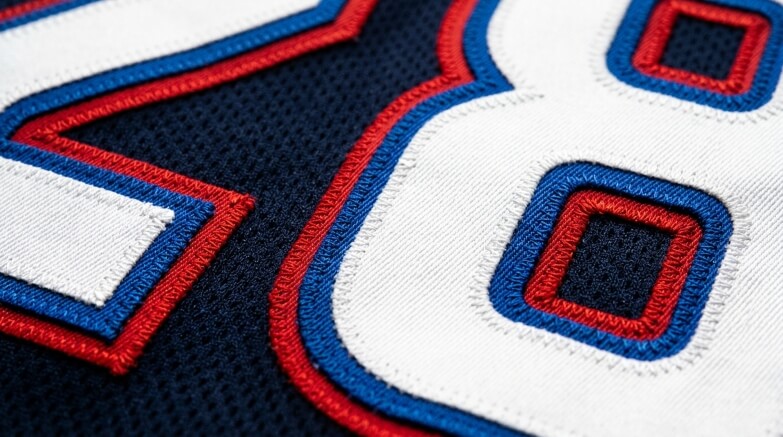
Numbers and letters are cut from twill fabric (a durable, slightly textured weave) and then sewn directly to the jersey. Double-stitched seams run around the perimeter. On premium applications, layers of twill are stacked (kiss-cut) to create depth. Used on NFL, NHL, and MLB authentic jerseys, tackle twill is visually distinct from heat-applied finishes because the material has its own texture separate from the jersey fabric. It requires more production time and cost per unit and is not practical for very large batches at low price points.
Heat Transfer Vinyl
Mass-market and fan-tier
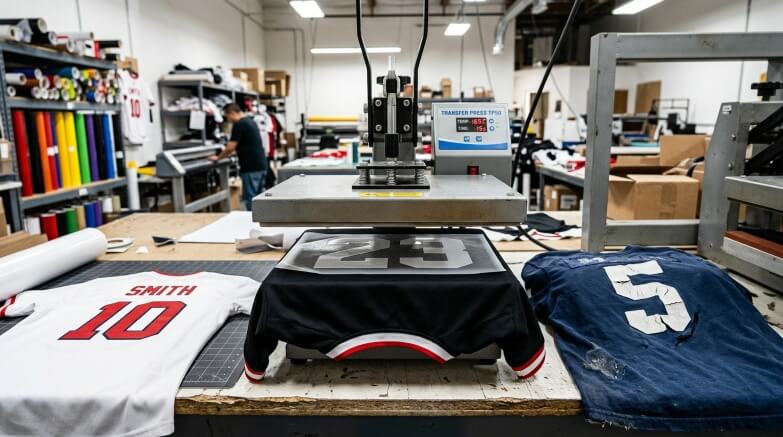
The number is cut from vinyl sheeting using a plotter cutter, then bonded to the jersey using a heat press at controlled temperature and pressure. The method is fast and consistent, and it allows personalisation after the base jersey is already produced – a retailer can add a name and number to an existing stock item the same day. The flat, slightly glossy surface is visually identifiable at close range. Quality varies: premium vinyl adheres cleanly for several years. Low-grade vinyl can separate at the edges after repeated washing. It is the most common method for fan-tier jerseys across all sports and for school and amateur team orders.
Sublimated Numbers
All-over design integration
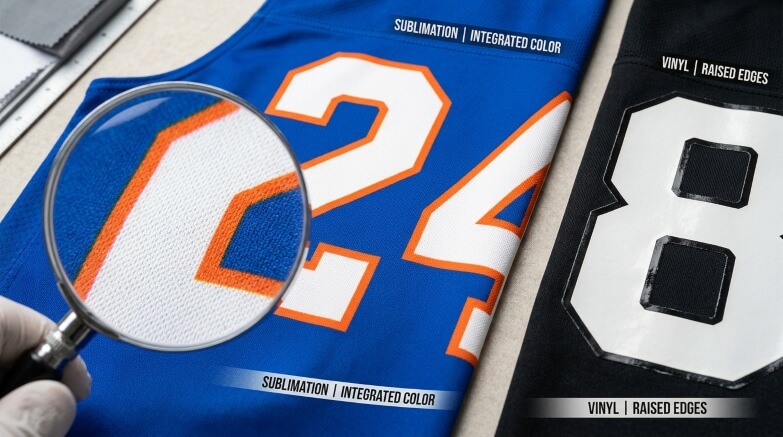
Numbers are designed into the garment file before printing. The number becomes part of the fabric’s colour rather than a separate layer on top of it, which means no peeling, no cracking, and no edge separation, because there is no edge. The number is as permanent as the fabric itself. This method is only possible during the initial sublimation printing of the full garment. It cannot be added retroactively, and all sizes must be determined before production begins. Common for youth leagues, esports kits, and custom team sets, where the entire design is produced in one print run.
REMEMBER
To check whether numbers are tackle twill or heat transfer vinyl: press your fingertip firmly across the edge of a number and feel for a seam. Tackle twill has a stitched edge you can feel as a slight ridge. Heat transfer vinyl has a sharp, smooth edge that may flex slightly if pressed. Sublimated numbers have no edge at all, the surface is uniform with the surrounding fabric.
What Affects Jersey Production Timelines
Production time usually comes down to four main factors, and they often interact with each other.
- Decoration method is the first. Embroidery requires the design to be digitised before stitching can begin. Screen printing needs a separate screen for each colour – a four-colour design means four screens prepared before printing starts. Sublimation typically takes the longest upfront because the entire design must be finalised before the fabric is printed. If something changes later, the fabric has to be printed again.
- Order volume also plays a role. Larger runs are usually faster per jersey because setup only happens once. However, producing 200 jerseys still takes more total time than producing 20. For that reason, manufacturers often provide different lead-time estimates depending on the order size.
- Design complexity adds another layer. Gradients, photographs, sponsor logos, sleeve patches, and unusual fonts each introduce extra steps. Very fine text or detailed graphics can also trigger a pre-production proof, which adds time but helps avoid mistakes.
- Artwork preparation is the fourth factor that often surprises first-time buyers. If files arrive in the wrong format or at low resolution, production can’t start until the artwork is corrected or recreated. That small delay at the beginning can easily push the entire timeline back.
WATCH OUT
Providing artwork in the wrong format is the most common cause of avoidable delays in custom jersey orders. Decoration methods that involve screen printing or embroidery require vector files (typically .AI, .EPS, or high-resolution .PDF formats), because the artwork needs to be scaled to exact size without quality loss. Submitting a rasterised image (.JPG or .PNG) at low resolution will require the manufacturer to either recreate the artwork or return it for correction before production can begin.
How to Check Quality Before It Ships
Six areas reward close inspection before items are distributed. Problems found now can be raised with the supplier. Problems found after distribution are harder to address.
01 Stitching Seams should be consistent in width with no loose threads visible on either face of the fabric. Double-stitching on numbers and name plates is standard at professional tier, single-stitched edges are a signal of lower-cost production. | 02 Alignment Numbers and names should sit precisely centred on the back panel. Check horizontal alignment against the collar midpoint and the hem midpoint, they should match. Names that sit at an angle to the shoulder line indicate a positioning error in production. |
03 Print Edge Integrity On heat-transfer applications, press the edge of each number firmly with a fingernail. A secure bond will not lift. Any lifting at the edges before the jersey is washed is a production indicator, the temperature or pressure during pressing was insufficient. | 04 Fabric Recovery Stretch the jersey body by approximately 25% of its width, hold for three seconds, and release. Quality performance polyester returns to its original shape within one to two seconds with no visible distortion remaining. Permanent stretch marks after this test indicate lower-grade fabric. |
05 Colour Consistency Compare the chest front, back panel, and sleeve panels in the same lighting. Sublimated and screen-printed jerseys from the same production run should show no visible tonal variation between panels. Inconsistency across panels suggests different print runs were combined. | 06 Label and Tag Accuracy The care label should specify the fabric composition and washing instructions. For sublimated polyester jerseys: machine wash cold, no tumble dry, no bleach. Heat-applied vinyl finishes require inside-out washing and low-temperature drying to extend the life of the bond. |
Common Mistakes When Ordering Custom Jerseys
Custom jersey orders fail in predictable ways. Most errors fall into one of four categories: size selection, design file problems, decoration method mismatch, and insufficient pre-production review.
Size selection is the most common error for first-time buyers ordering team kits. Sports jersey sizing is not standardised across sports or even across manufacturers within the same sport. The safest approach is to request a size chart with chest measurements in centimetres or inches and check against actual measurements rather than relying on labelled size alone.
Design file issues delay a larger percentage of orders than buyers typically expect. Any text in the design should be converted to outlines before submission, a font installed on the buyer’s computer may not be available at the production facility. Colours should be specified in Pantone (PMS) values; RGB or hex values render differently across output methods.
Decoration method mismatch happens when a buyer requests a method that is technically incompatible with their design. A full-colour gradient cannot be screen-printed. Embroidery cannot reproduce text below approximately 6–7mm with legibility. Sublimation cannot be applied to a pre-existing dark garment. Knowing which method suits a given design before placing an order prevents misunderstandings about the finished product.
Skipping or shortening the proof review is the fourth major error. Approving a proof without checking every element, or skipping it to accelerate delivery, removes the only opportunity to catch production mistakes before the full run is completed.
Common Custom Jersey Questions
Tackle twill is more durable under active play but adds time and cost. Vinyl is faster, allows post-production personalisation, and works well for fan-wear. The two methods have different lives under different conditions: vinyl on a fan jersey typically lasts several years of normal wear; the same jersey worn in daily training would degrade it faster.
Screens use RGB light values. Screen printing uses Pantone or CMYK ink. Sublimation uses dye bonded to polyester fibres. Each system has a different colour gamut: the same hex value appears differently across all three. Fluorescent and highly saturated colours are most likely to shift. The correct solution is to approve colours against a physical swatch or test print, not a digital preview.
Almost always one of three causes: below-standard vinyl, incorrect heat press temperature or pressure during production, or washing and drying at too high a temperature. Washing at 60°C or above, or tumble-drying at high heat, degrades the bond regardless of initial quality. Most custom jersey care instructions specify cold wash and air dry for this reason.