
College and NFL jerseys often look almost identical on TV. The colours, numbers, and construction at the premium tier are largely the same. But what actually separates them isn’t the fabric, it’s the rules. For decades, different legal frameworks determined who could profit from a player’s name and how long those restrictions lasted. Let’s find out why.
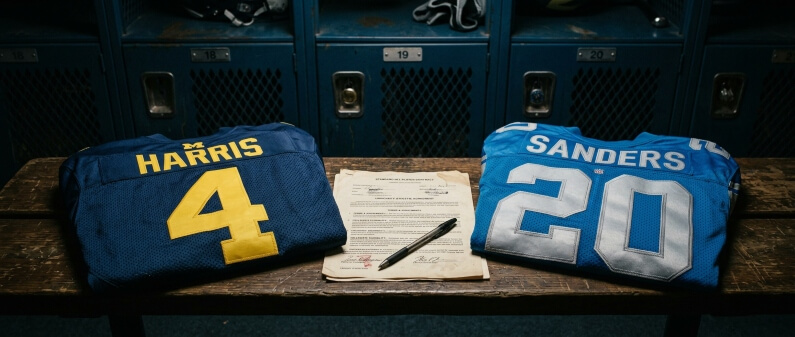
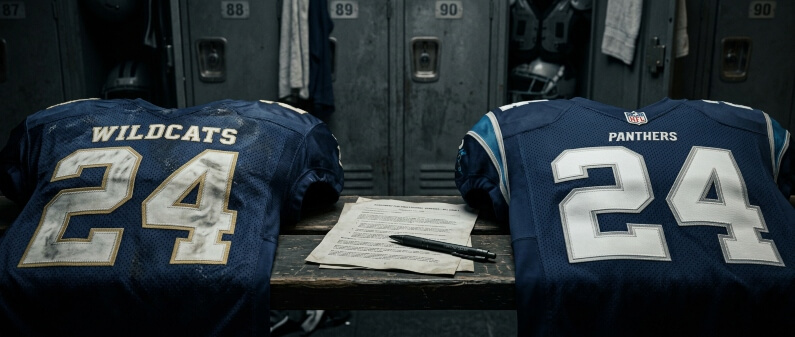
Why NCAA Jerseys Were Sold Without Player Names
For most of college football’s commercial history, jerseys sold at university bookstores, licensed retailers, and online channels carried a number but no name.
This was not a design choice. It was a direct consequence of NCAA amateurism rules. A player’s name was their commercial property, and selling a jersey with their surname on the back would have constituted an indirect commercial benefit, threatening their eligibility.
1905 NCAA Founded | 1956 Grant-in-Aid | 1984 NCAA v. Board | 2019 California Fair Pay Act | July 2021 NIL Rules Suspended | June 2025 House Settlement |
|---|---|---|---|---|---|
National Collegiate Athletic Association established. Amateurism rules adopted from British university sports model. | NCAA authorises athletic scholarships. Players can receive tuition, room, board, but nothing resembling payment for performance. | Supreme Court rules NCAA cannot control TV broadcast rights, first crack in amateurism’s commercial monopoly. | California passes first state law allowing college athletes NIL rights. Forces NCAA to begin internal review. | NCAA suspends NIL rules nationwide. Players can now earn from third-party endorsement deals. | House v. NCAA settlement approved. Schools can pay athletes directly up to $20.5M per year from athletic revenue. |
Penn State formally removed player names from its uniforms in 2012 to return to what the programme described as its historical identity.
ONE MORE DETAIL
The NCAA rules applied to retail merchandise, not to the jerseys worn on the field. On-field college jerseys have carried player names since the 1960s in most programmes. The restriction was specifically on what universities, and their licensed manufacturers could sell commercially.
NIL Changed Everything: What College Jersey Rules Look Like Now
The suspension followed a 2021 Supreme Court ruling in NCAA v. Alston and pressure from state NIL laws across more than half of US states. Rather than face a fragmented legal landscape, the NCAA stood down.
The immediate effect for jersey merchandise was significant: universities and their licensing partners could now sell jerseys with player names, and players could receive a share of revenue through NIL deals. EA Sports announced the return of its College Football series (EA College Football 25, July 2024) with licensed player likenesses for the first time.
The deeper shift came through the House v. NCAA settlement, which received final approval on June 6, 2025. It established a $2.8 billion back-payment fund for former athletes who competed between 2016 and 2024. It also created a framework allowing Division I schools to pay athletes directly up to approximately $20.5 million per school per year beginning with the 2025-26 academic year.
“Approving the agreement reached by the NCAA opens a pathway to begin stabilizing college sports. This new framework enables schools to provide direct financial benefits to student-athletes.”
— NCAA President Charlie Baker, June 2025
Roughly 75% of those payments are expected to go to football players, 15% to men’s basketball, 5% to women’s basketball. The college jersey market now operates closer to the professional model than at any point in the sport’s history.
WATCH OUT
The NIL era does not mean all player-name jerseys on the market are officially licensed. The volume of unofficial merchandise featuring college player names has grown since 2021. Officially licensed jerseys carry NFLPA or institution-specific licensing marks. Unofficial products may use a player’s number and school colours without a direct licensing agreement which is a different category from an authentic licensed retail jersey.
Michael Jordan at North Carolina, Tom Brady at Michigan: Why These Sell
Some college jerseys maintain demand for decades after the player left campus. The professional career retroactively amplifies the college moment, the jersey becomes the origin document.
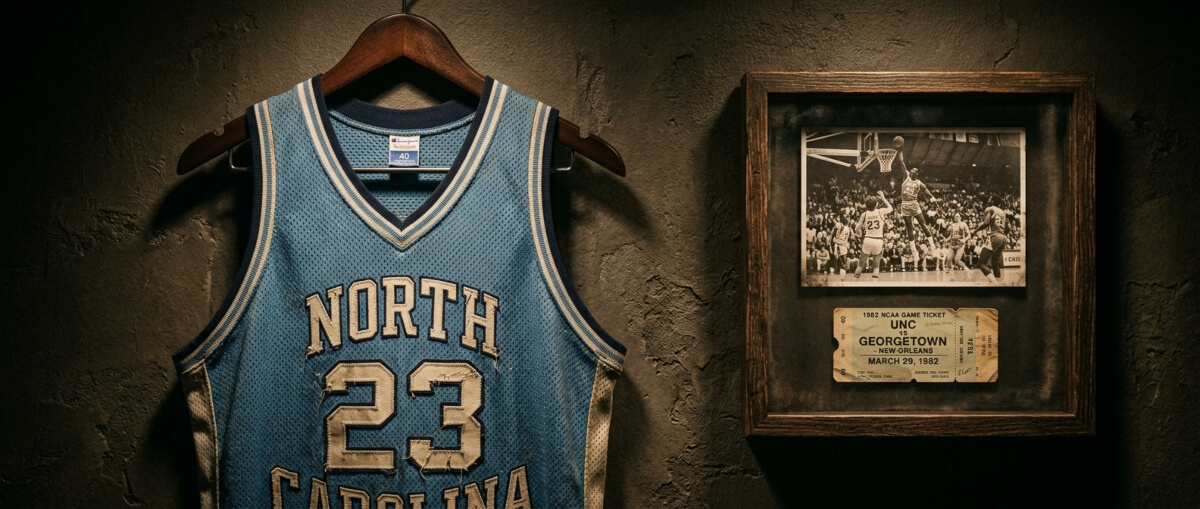
The North Carolina Jordan jersey and Jordan UNC jersey are two of the most searched college basketball jersey terms in North America, both referring to the same garment: Jordan’s #23 UNC Tar Heels uniform from 1981 to 1984.
UNC
#23
North Carolina
Basketball · 1981–84
1982 NCAA Champion
3 seasons · 17.7 ppg
First team All-American 1983 and 1984
Jordan enrolled at UNC in 1981, was named ACC Freshman of the Year, and averaged 13.4 points on 53.4% shooting.
On March 29, 1982, at the Louisiana Superdome, Jordan hit a jump shot from the left wing with 15 seconds remaining to give UNC a 63-62 lead over Georgetown in the NCAA Championship Game. He finished with 16 points and a team-high nine rebounds.
He played two more seasons at UNC before being selected third overall in the 1984 NBA Draft. The UNC #23 is the only college jersey he wore.
Jordan wore #15 at the 1984 Olympics. His NBA retirement jersey was #23 with the Bulls. The UNC #23 connects all three phases.
Michigan
#10
Michigan Wolverines
Football · 1995–99
20-5 as starter
1999 Citrus Bowl win
2000 Orange Bowl win (OT, 35-34 vs. Alabama
Brady sat seventh on Michigan’s depth chart early in his career and nearly transferred to California. He stayed. As a starter in 1998 and 1999, Brady went 20-5 and capped his career with an overtime win over Alabama in the Tom Brady Michigan jersey’s defining moment – the 2000 Orange Bowl, throwing for 369 yards and four touchdowns. He was drafted 199th overall. The Michigan #10 jersey is the starting point for the most decorated quarterback career in NFL history.
Michigan
#2
Michigan Wolverines
Football · 1995–97
1997 Heisman Trophy
Only primarily defensive Heisman winner
1997 national champion
Charles Woodson is the only primarily defensive player in college football history to win the Heisman Trophy.
The award was and remains controversial in some quarters, with Manning supporters arguing a quarterback’s statistical contribution outweighed Woodson’s.
Woodson’s supporters noted he was making significant plays on both sides of the ball in the same game – something that had essentially not happened in major college football since the two-platoon system took hold in the early 1960s.
NFL Authentic vs Replica: What the $200 Price Gap Buys You
Nike replaced Reebok as the official NFL manufacturer in 2012. What Reebok called ‘authentic’ and ‘replica’ became Nike’s ‘Elite’, ‘Limited’, and ‘Game’. Three tiers at different price points and construction specs.
GAME ~$100–120 CAD | Screen-printed numbers, letters, and graphics – print sits on top of the fabric, not stitched into it. Lightweight polyester with mesh ventilation panels. Relaxed fit. Jock tag shows S/M/L/XL sizing. |
LIMITED ~$150–200 CAD | Heat-sealed or stitched twill name and number patches – numbers have a raised, layered quality rather than a flat printed appearance. Dri-FIT, tagless neckline, tailored fit. Note: pre-2023 production used fully stitched lettering; post-2023 uses heat-sealed patches on some versions. |
ELITE ~$300–350+ CAD | Nike’s closest consumer equivalent to the on-field jersey. Nylon-spandex blend, Flywire collar, water-repellent fabric, strategic vents. Sewn-on twill numbers (flexible, not rigid. NFL shield is applique, not embroidered) an embroidered shield on an Elite-tier jersey is a counterfeit indicator. Numeric sizing: 40–60+; a numeric 44 is approximately a standard L. |
NOTE
For autograph purposes: Game jerseys accept marker (Sharpie) signatures only, since the screen print surface is incompatible with paint pen. Limited and Elite jerseys accept both paint pen and marker. Most dealers and collectors prefer Limited or Elite for signed pieces because the paint pen signature has a more visible contrast against stitched fabric.
How NFL Teams Assign Jersey Numbers (and When Players Can’t Change Them)
The NFL standardised jersey numbers by position in 1973. The system lasted largely unchanged for 48 years, until the Kansas City Chiefs submitted a rule-change proposal approved by owners on April 21, 2021.
Practice squads had grown to 16 players and positions were running out of available numbers. The Chiefs’ proposal expanded ranges for most non-lineman positions. The Eagles then added #0 in March 2023 – the first time it had been available since 1973.
Position Group | Eligible Range | Context |
|---|---|---|
Quarterbacks | 0–19 | The traditional QB range. #0 added in 2023 – Calvin Ridley and D’Andre Swift were early adopters. |
Wide Receivers, Running Backs, TEs, DBs | 0–49 (+ 80–89 for WRs/TEs) | The 2021 rule change opened up 0–49 to most skill positions. Prior to 2021, running backs and defensive backs were restricted to 20–49, while wide receivers and tight ends used 80–89. |
Offensive Linemen | 50–79 | Unchanged since 1973. Linemen stay in this range for the eligible receiver rule, only players outside 50–79 can catch a legal forward pass without reporting to an official. |
Defensive Linemen | 50–79 90–99 | Defensive linemen share the 50–79 range with offensive linemen, plus can use 90–99, the traditional d-line range that many players and fans still associate with pass rushers and defensive tackles. |
Linebackers | 0–59 90–99 | Previously 50–59 only. 2021 expansion opened 0–59 and 90–99, which is why a linebacker wearing #8 no longer means an eligible receiver report. |
Number changes carry an informal cost: incoming players sometimes compensate teammates who hold their preferred number. Aaron Rodgers switched from #12 to #8 joining the Jets in 2023 – #12 was retired for Namath.
HERE’S THE KEY POINT
The NFL officially discourages (but does not prohibit) teams from retiring numbers. The concern is that retiring numbers depletes the available pool at each position. Some teams retire numbers formally; others informally stop issuing a number without a public ceremony. The practical effect on merchandising is the same: a retired number sells as a historical item rather than a current-roster item.
Justin Jefferson at LSU, Justin Fields at Ohio State: College Throwback Context
College throwbacks reference a compressed moment – a championship season, a Heisman year, one game. Below we cover the most-referenced jerseys and why they still generate search volume.
Player / School | Era | Why the Jersey Carries Meaning |
|---|---|---|
Justin Jefferson LSU Tigers #2 | 2019 season | 15-0, Joe Burrow won the Heisman, 726-252-point differential. Jefferson caught 111 passes for 1,540 yards, an SEC single-season record, in Joe Brady’s spread offence. |
Justin Fields Ohio State Buckeyes #1 | 2019–20 seasons | Fields transferred from Georgia for 2019, led Ohio State to a Big Ten title, and took the Buckeyes to the CFP in both his seasons including the 2020 national championship game. #1 had not been worn by an Ohio State QB in the modern era. |
CeeDee Lamb Oklahoma Sooners #2 | 2019 season | Lamb won the Biletnikoff Award in 2019: 62 catches, 1,327 yards, 14 touchdowns. The OU jersey is the only reference point before his professional career – one season that moved him from prospect to top five pick. |
Ja’Marr Chase LSU Tigers #1 | 2019 season | Chase played in the same 2019 LSU offence as Jefferson: 84 catches, 1,780 yards, 20 touchdowns. Both LSU #1 and #2 come from the same championship season – two active NFL starters, one origin point. |
DeMar DeRozan USC Trojans #10 | 2008–09 season | DeRozan played one season at USC before being selected 9th overall in the 2009 NBA Draft. He averaged 13.9 points and 5.7 rebounds as the Trojans’ leading scorer. The USC #10 is the only college jersey associated with one of the most durable NBA careers of his generation – 19 seasons, six All-Star selections, a Bulls scoring title in 2021-22. |
Charles Woodson Michigan Wolverines #2 | 1995–1997 | The only primarily defensive Heisman winner (1997), edging Manning by 282 votes. Two-way contributor: corner, punt returner, receiver. Michigan went undefeated and shared the national title. The Charles Woodson Michigan jersey is the programme’s most referenced defensive player piece. |
Jaylen Waddle Alabama Crimson Tide #17 | 2018–2020 | Waddle was one of Alabama’s most explosive receivers before a season-ending ankle injury in 2020. He had recorded 591 receiving yards in just five games of his final season before the injury, a pace that made the truncated season feel like an incomplete picture. The Alabama #17 is partly a reference to what fans saw and partly to what the injury prevented. |
Russell Wilson NC State Wolfpack #16 | 2008–2010 | Wilson spent three seasons at NC State before transferring to Wisconsin for his final year. He threw for 8,545 yards and 76 touchdowns as a Wolfpack starting quarterback. The NC State jersey predates the Wisconsin and NFL phases of his career, making it a specific reference to a less-documented part of his development. |
QUICK TIP
College jerseys referencing the same season can carry different weight depending on what the player did after leaving. Justin Jefferson’s LSU #2 benefits from his NFL career with the Vikings amplifying the 2019 season’s significance retroactively. Ja’Marr Chase’s LSU #1 benefits from the same effect. Both players are now established NFL starters, which makes the 2019 LSU jersey a shared reference point for two active careers, not just one.
FAQ: College and NFL Jersey
Yes. Since July 2021, the NCAA’s suspension of NIL rules allows universities and licensed partners to sell jerseys with player names. Athletes can earn from NIL deals tied to their name and likeness in merchandise. The House v. NCAA settlement (June 2025) goes further, allowing schools to pay athletes directly from athletic revenue.
Some schools chose it as tradition rather than a rule. Penn State, for example, removed player names in 2012 to emphasize team identity over individuals. The idea is that the school name on the front matters more than the player name on the back.
Charles Woodson won the 1997 Heisman Trophy as the only primarily defensive player ever to win the award. Since the Heisman almost always goes to offensive players, Woodson’s win remains a rare moment in college football history, which makes the Michigan #2 jersey uniquely significant.